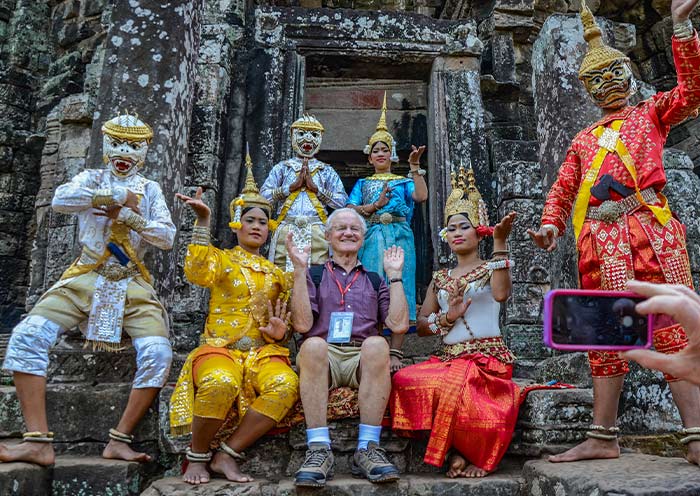
Southeast Asia is home to some of the world's most magnificent temples — soaring stone monuments, gilded pagodas, and serene monasteries that have stood for centuries.
From the Khmer temples of Cambodia to the Buddhist stupas of Myanmar, the island shrines of Indonesia, and the gilded wats of Thailand and Laos, the region's religious architecture spans more than a millennium of art, empire, and faith. This list balances the unmissable icons with a few quieter gems, and it pairs naturally with our Asia tours across Thailand, Cambodia, Vietnam, Indonesia, Myanmar, and Laos. Wherever you start, remember the basics: cover shoulders and knees, remove shoes where asked, and never touch statues or monks (especially women approaching a monk).
1. Angkor Wat — Cambodia
The largest religious monument in the world, Angkor Wat is the crown jewel of Southeast Asian temples. Built in the 12th century, arrive before dawn to watch the sun rise behind the iconic lotus-shaped towers.
The temple was originally dedicated to the Hindu god Vishnu and later transformed into a Buddhist site. Its bas-reliefs stretch for hundreds of meters and depict scenes from the Hindu epics. Allow at least a half day, and buy the multi-day pass to combine sunrise here with the Bayon and Ta Prohm nearby.
2. Wat Phra Kaew — Bangkok, Thailand
Located within the Grand Palace complex, Wat Phra Kaew (Temple of the Emerald Buddha) is Thailand's most sacred temple. The emerald Buddha sits atop an elaborate golden altar.
The small jade statue, just 66 centimeters tall, is the palladium of the Thai kingdom, and only the king may approach it. The surrounding cloister is lined with gilded chedis and murals of the Ramakien epic. Dress modestly and arrive early to avoid the crowds and heat.
3. Shwedagon Pagoda — Yangon, Myanmar
Rising 99 meters above Yangon, the Shwedagon Pagoda is covered in gold plates and topped with thousands of diamonds — including a 76-carat diamond at the tip.
The stupa is said to hold hairs of the Gautama Buddha, and it has been a pilgrimage site for more than 2,500 years. Visit at dusk, when the gilded dome glows against the evening sky and devotees circle the platform with candles and lotus offerings.
4. Borobudur — Java, Indonesia
The largest Buddhist temple on Earth, Borobudur consists of nine stacked platforms adorned with 2,672 relief panels and 504 Buddha statues.
Built in the 9th century and abandoned for centuries before being restored under UNESCO, Borobudur sits in misty hills near Yogyakarta. Sunrise visits, when the volcanoes of central Java emerge from the fog, are legendary. Climb slowly: the upper terraces are meant to be a pilgrimage in stages.
5. Wat Rong Khun — Chiang Rai, Thailand
The White Temple is a contemporary masterpiece. Its dazzling white exterior symbolizes purity, while the bridge over reaching hands represents the path to enlightenment.
Designed by Thai artist Chalermchai Kositpipat and still under construction, Wat Rong Khun blends traditional Buddhist themes with modern imagery, including murals featuring global pop-culture figures. It is a short drive from Chiang Rai and pairs well with a northern Thailand hill tribe trek.
6. Prambanan — Java, Indonesia
This 9th-century Hindu compound features 240 temples, with the three main shrines dedicated to Shiva, Vishnu, and Brahma rising 47 meters high.
Prambanan is a short drive from Yogyakarta and often visited alongside Borobudur. The main shrines are decorated with carved scenes from the Ramayana, and an open-air Ramayana ballet is performed against the temple on selected nights. Sunrise and sunset visits offer the softest light.
7. Wat Xieng Thong — Luang Prabang, Laos
The "Temple of the Golden City" is Luang Prabang's most important monastery, with sweeping tiered roofs that epitomize classic Lao temple architecture.
Founded in the 16th century, Wat Xieng Thong sits on the northern tip of the UNESCO-listed peninsula where the Nam Khan meets the Mekong. Its rear wall features the famous glass mosaic tree of life. Pair the visit with the early-morning alms-giving ceremony (tak bat) that runs through Luang Prabang's streets.
8. Bagan Temples — Myanmar
More than 2,000 temples dot the Bagan plains. Rent an e-bike at dawn and explore the Ananda, Dhammayangyi, and Thatbyinnyu temples.
Between the 11th and 13th centuries, over 10,000 Buddhist temples were built across this plain, making it one of the densest concentrations of religious architecture on Earth. Balloon flights at sunrise are an unforgettable way to see the spires emerge from the mist. Note that climbing most temple roofs is now restricted to protect the structures.
9. Wat Arun — Bangkok, Thailand
The Temple of Dawn, with its distinctive Khmer-style spire, is best seen at sunset when the sun illuminates the colorful porcelain mosaics.
Rising 82 meters on the west bank of the Chao Phraya River, Wat Arun is decorated with fragments of Chinese porcelain and glass. Climb the steep central prang for river views, then watch the temple light up as dusk falls. It pairs naturally with a first-time Bangkok itinerary.
10. Ta Prohm — Siem Reap, Cambodia
Famous as the "Tomb Raider temple," Ta Prohm has been left in its jungle-consumed state, with massive trees growing through the stone ruins.
The temple was built in the late 12th century as a Buddhist monastery and university, and when it was rediscovered, conservationists chose to leave it in place to show how the jungle reclaims stone. Visit early in the morning to avoid the tour buses. For more Cambodia beyond the temples, our guide to Cambodia beyond Angkor Wat continues the route.
Planning a Temple Route Across the Region
Because these temples span several countries, most travelers build a focused route rather than trying to see them all at once. A two-week Thailand and Cambodia loop can combine Bangkok's Wat Phra Kaew and Wat Arun with Angkor Wat and Ta Prohm. A Java, Indonesia trip pairs Borobudur and Prambanan near Yogyakarta. A Myanmar and Laos route threads Bagan's plains through to Luang Prabang's Wat Xieng Thong. Entry fees, dress codes, and opening hours vary, so check each site's official guidance before you go, and hire local guides where the history is dense. If you want to extend beyond temples, our list of the top places to visit in Asia covers the wider bucket list.
Frequently Asked Questions
What is the most beautiful temple in Southeast Asia?
It comes down to taste: Angkor Wat is the grandest, Borobudur the most spiritual at sunrise, Shwedagon the most dazzling, and Wat Arun the most romantic at sunset. Any first-time route through the region should include at least two or three of them.
What should I wear to Southeast Asian temples?
Cover shoulders and knees at Buddhist and Hindu sites, and remove shoes when entering indoor sanctuaries. Sarongs are often available at the busiest temples. Avoid pointing your feet at Buddha images, and do not touch statues or monks.
Can I see all these temples on one trip?
Not realistically in one trip, as they span Cambodia, Thailand, Myanmar, Indonesia, and Laos. Most travelers build a multi-country route over several visits. Our Asia tours can pair, for example, Thailand and Cambodia, or Indonesia's Java temples, into focused two-week itineraries.
When is the best time to visit temples in Southeast Asia?
The cool, dry season from November to February is ideal across much of the region. For specific countries, see our month-by-month guide to the best time to visit each Asian country.
Want to stand before Angkor Wat at dawn or drift over Bagan by balloon? Our Asia tours build multi-country routes around the temples that matter most to you. Tell us your dream list and we will map the route, the seasons, and the guides.