Let's address the elephant in the room: Bhutan is expensive. The Sustainable Development Fee (SDF) is US$100 per person per night. Is it worth it? Absolutely. Here's why.
Bhutan is the last surviving Himalayan Buddhist kingdom, a land where development is measured not by Gross Domestic Product but by Gross National Happiness. Tucked between India and China, it was closed to outsiders until 1974 and today welcomes only a carefully managed stream of visitors. If you have ever dreamed of a place where forests cover more than 70 percent of the country, where the constitution mandates that it stay that way, and where every public space opens with a prayer flag flutter, Bhutan is that place. This guide breaks down exactly what you are paying for, what you will see, and whether the Kingdom of Happiness deserves a spot on your itinerary. For neighboring Himalayan options, see our Nepal tours and the Lhasa to Kathmandu overland guide.
What the SDF Actually Pays For
The SDF directly funds: free healthcare for all Bhutanese, free education including university, environmental conservation (Bhutan is carbon-negative — the only country on Earth), infrastructure, and poverty reduction.
Roughly 72 percent of Bhutan remains forested, and the country absorbs more carbon than it emits — a fact enshrined in its 2008 constitution, which requires at least 60 percent of the land to remain under forest cover for all time. The SDF also finances the country's network of dzongs (fortress-monasteries), trail maintenance, and the famous driglam namzha dress code that keeps Bhutanese culture visibly alive. When you pay the fee, you are not paying a resort tax — you are funding a national model that the rest of the world is only beginning to study.
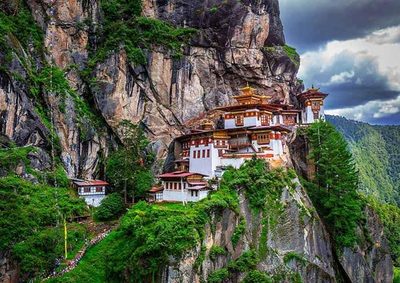
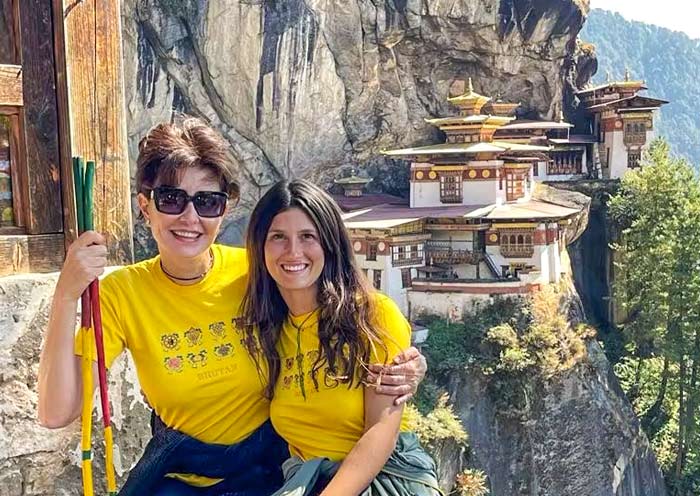
Tiger's Nest Monastery (Paro Taktsang)
Clinging to a cliff 900 meters above the Paro Valley, the hike takes 4-5 hours round trip. The first glimpse of the monastery emerging from the mist is unforgettable.
Perched at 3,120 meters on a sheer granite face, Paro Taktsang is Bhutan's most sacred site and the meditation cave where Guru Rinpoche, the 8th-century saint who brought Buddhism to Bhutan, is said to have landed on the back of a flying tigress. The trail climbs through pine forest draped in Spanish moss, passes a waterfall viewpoint and a cafe where most visitors pause for butter tea, and finally crosses a swinging prayer-flag bridge to the monastery courtyard. Wear sturdy shoes, start early to avoid afternoon clouds, and plan for 2-3 hours down. Entry to the main temple itself is restricted to Bhutanese Buddhists, but the exterior terraces offer views that reward every step.
Gross National Happiness
Bhutan measures Gross National Happiness instead of GDP. You feel it everywhere — in the unhurried pace of life, genuine smiles, and deep connection to Buddhist values.
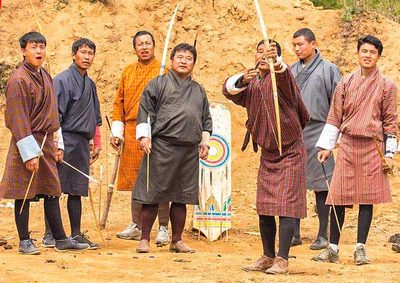
The policy, introduced in the 1970s by the fourth Dragon King, governs five pillars: cultural preservation, environmental conservation, good governance, socio-economic development, and disaster resilience. In practice it means you will see farmers in woven gho and kira walking to village temples, archery tournaments on every village green, and television only arriving in 1999. It also means Bhutan deliberately limits high-volume, low-value tourism — a policy that keeps the country clean, quiet, and authentic, but is exactly why prices remain high.
Beyond Tiger's Nest: What Else to See
- Punakha Dzong: A 17th-century fortress at the confluence of the Mo Chu and Pho Chu rivers, reached by a dramatic suspension bridge. It is the most beautiful dzong in Bhutan and the site of the current king's coronation.
- Paro Valley: Bhutan's rice bowl, home to the 15th-century Drukgyal Dzong ruins and the Ta Dzong National Museum, housed in a circular watchtower.
- Thimphu: The world's smallest capital, with no traffic lights (a single roundabout replaced them after residents protested), the giant Buddha Dordenma statue (51 meters tall, containing 100,000 smaller bronze Buddhas), and the weekend craft market.
- Phobjikha Valley: A glacial wetland and winter home to the endangered black-necked crane, best visited November through February.
- Dochu La Pass: A 3,100-meter pass on the road from Thimphu to Punakha, lined with 108 chortens and sweeping Himalayan views on clear days.
Practical Costs (2026)
- SDF: US$100 per person per night
- Tour package: $250-400 per person per day (standard)
- Total for 7-day trip: ~$2,500-3,500 per person
Because independent travel is not permitted in Bhutan, all visitors must book through a licensed local operator, and the SDF is paid upfront as part of that package. Packages typically include a guide, driver, all meals, accommodation, and entry fees. High-season surcharges of $30-50 per night apply during the peak months of March-May and September-November. Luxury stays like Amankora, Six Senses, and Como Uma Paro push the daily rate well above $1,000 per person.
Best Time to Visit Bhutan
| Season | Months | Highlights |
|---|---|---|
| Spring | March-May | Rhododendron blooms, clear views, Paro Tshechu festival in March/April |
| Summer (Monsoon) | June-August | Greenest landscape, lowest prices, occasional rain |
| Autumn | September-November | Crystal skies, Thimphu Tshechu, best mountain views |
| Winter | December-February | Cold but clear, black-necked cranes in Phobjikha, quiet trails |
Festivals & Food
Bhutan's tshechus (annual Buddhist dance festivals) are the country's biggest communal events. The Paro Tshechu (March/April) and Thimphu Tshechu (September/October) draw thousands in traditional dress, with masked cham dances reenacting the triumph of Buddhism over evil. If you travel during a tshechu, plan early — hotels sell out months in advance and room rates jump 30-50%. Food is simple and hearty: ema datshi (chilies in cheese), phaksha paa (pork with turnip), jasha maroo (spicy chicken), and butter tea. Rice is red, buckwheat pancakes are common in the east, and ara (local rice wine) flows at every festival.
Frequently Asked Questions
Is Bhutan really worth the high cost?
For travelers who value authenticity, unspoiled nature, and a deeply preserved Buddhist culture, yes. You are essentially paying to enter a protected kingdom that has chosen limited tourism over mass development. If your priority is budget backpacking or partying, Bhutan is not the right choice.
Can I travel independently in Bhutan?
No. All visitors must book through a licensed Bhutanese tour operator, and the SDF must be prepaid. The only exception is Indian, Bangladeshi, and Maldivian passport holders, who pay a reduced fee and may arrange their own logistics.
Do I need a visa for Bhutan?
Yes. Your tour operator handles the visa application after you pay the SDF. You receive a visa clearance letter, which you present upon arrival at Paro International Airport (PBH). Flights to Bhutan are operated exclusively by Drukair and Bhutan Airlines, usually routed through Delhi, Kathmandu, Bangkok, or Singapore.
How many days do I need in Bhutan?
Seven days is the minimum to comfortably cover Paro, Thimphu, and Punakha. Ten to twelve days allows adds Bumthang (the cultural heart in central Bhutan) and Haa Valley. If you are pairing Bhutan with Nepal, two weeks combined works well.
Bhutan is not a destination to check off a list — it is a destination that stays with you. Tell us your travel dates and we will design a private Bhutan itinerary that balances the tiger's nest hike, dzong visits, and quiet valley mornings. You can also explore our broader Asia tours to pair Bhutan with Nepal, India, or Sri Lanka.