Central Asia is experiencing a tourism renaissance, with easier visas, improved infrastructure, and a growing appetite among travelers for destinations that feel undiscovered.
For decades, the five "Stans" of Central Asia — Kazakhstan, Kyrgyzstan, Tajikistan, Turkmenistan, and Uzbekistan — were a blank on most travelers' maps. Today, they are the fastest-growing corner of the Silk Road world, combining UNESCO cities, high mountains, nomadic culture, and a surprisingly warm welcome. This is why Central Asia is 2026's hottest destination.
Why Now?
Three factors: visa liberalization (Uzbekistan now offers visa-free entry to 90+ nationalities), new flight routes, and social media (Samarkand's Registan is Instagram gold).
Add high-speed trains (the Afrosiyob in Uzbekistan), new boutique hotels in restored madrasahs, and a region actively marketing itself as the "new Silk Road." Travelers who once ended their China trip in Kashgar now continue west into Uzbekistan; others fly direct from Istanbul, Dubai, or Seoul into Tashkent or Almaty. The result: a region that still feels raw, but is no longer hard.
Uzbekistan: Where the Silk Road Lives
Samarkand's Registan Square is one of the world's most beautiful urban spaces. Bukhara's old town is a living museum of 140+ protected monuments.
Uzbekistan is the anchor of any Central Asia trip. In addition to Samarkand and Bukhara, the walled oasis city of Khiva, the modern capital Tashkent, and the desert mountains of Nurata offer two to three weeks of dense culture. Our companion guide, following the Silk Road through Samarkand and Bukhara, walks through every major monument. Plov, nan, and green tea are the everyday pleasures.
Uzbekistan's hotel scene has exploded: restored madrasah boutique hotels in Bukhara and Khiva now offer air-conditioned rooms with rooftop tea terraces, making a Silk Road pilgrimage comfortable as well as atmospheric. Domestic flights between Tashkent, Urgench, and Bukhara take under an hour and cost as little as $50.
Kyrgyzstan: The Switzerland of Central Asia
The Tian Shan mountains cover 90% of the country, offering world-class trekking, horse riding, and yurt stays at Song-Kul Lake.
Kyrgyzstan is Central Asia's adventure playground. Song-Kul Lake at 3,000m is the classic yurt-stay experience: wake to horse herders driving sheep across the high plateau, sleep in felt yurts, and try kumis (fermented mare's milk). The Issyk-Kul Lake is a giant alpine lake ringed by peaks, and the Ala Archa National Park near Bishkek offers day hikes to glaciers. Trekkers come for the 4-5 day alpine trails and the longer routes into the Pamir-Alai.
Kyrgyzstan is also where nomadic culture is most visible: staying in a family yurt camp at Song-Kul means sharing meals with a local herding family, riding horses across the plateau, and drinking fermented mare's milk. English guides are available in Bishkek and on the popular trekking routes, and wild-camping is legal almost everywhere.
Kazakhstan: Where Ancient Meets Futuristic
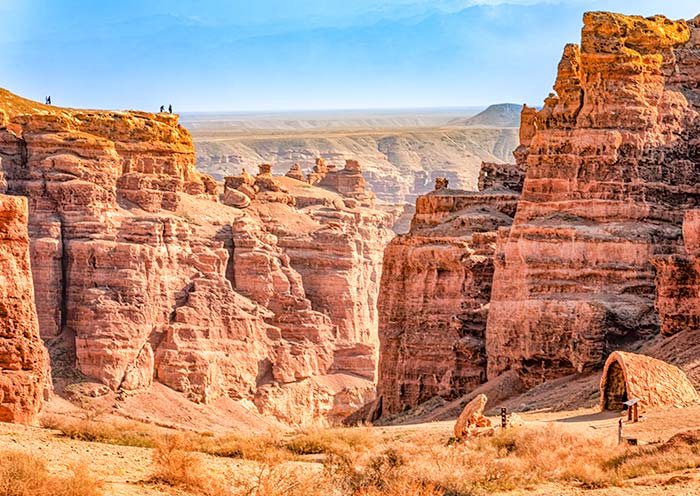
Almaty sits at the foot of snow-capped peaks. Charyn Canyon looks like the Grand Canyon's cousin. Nur-Sultan is a city of gleaming skyscrapers on the steppe.
Kazakhstan is the largest and most modern of the Stans. Almaty, the former capital, is a leafy, cafe-filled city with the Big Almaty Lake and the Shymbulak ski resort an hour away. Charyn Canyon National Park offers a day trip through 150km of red sandstone cliffs, and the Singing Dunes near Altyn-Emel are a natural wonder. Nur-Sultan (Astana) is a futuristic capital of pyramids and white marble, a deliberate statement of steppe ambition.
Kazakhstan is also the easiest Central Asian country for English-speaking travelers: visa-free for 90 days for most Western passports, with excellent roads, modern airports, and a cafe culture in Almaty that rivals European cities. The Kolsai Lakes near Almaty offer alpine hiking in summer and skiing at Shymbulak in winter.
Tajikistan: The Roof of the World
Tajikistan is the most mountainous country in the region, and home to the Pamir Highway, often called one of the world's great road trips. The 1,200-kilometer route from Dushanbe to the Kyrgyz border crosses 4,655-meter passes, glacial lakes (including Lake Sarez and Iskanderkul), and remote Pamir villages where Wakhi and Kyrgyz nomads still graze yaks. It is for adventurous travelers who want silence, altitude, and landscapes that look like Tibet.
Tajikistan is also home to the Fann Mountains, an easier alpine trekking region near the Uzbek border with turquoise lakes (Alauden, Mutnoe) and marked trails suitable for beginner-to-intermediate hikers. Dushanbe, the capital, is a leafy, safe city with an excellent tea-house culture and the National Museum of Antiquities.
Turkmenistan: The Closed Silk Road State
The fifth Stan, Turkmenistan, is the most restricted: independent travel requires a guided tour and a visa, but the payoff is extraordinary. Merv, one of the great Silk Road oasis cities and a UNESCO site, lies in ruins near modern Mary; the Darvaza Gas Crater (the "Door to Hell") is a burning natural gas pit in the Karakum Desert that has burned since 1971. Ashgabat itself is a marble-clad showcase capital on the edge of the desert.
What a Central Asia Trip Costs
Central Asia remains remarkably affordable compared with Europe or East Asia. Guesthouse rooms run $20-50, restaurant meals $5-10, and internal flights within Uzbekistan $50-100. Luxury upgrades — boutique madrasah hotels in Bukhara or private yurt camps at Song-Kul — push daily budgets toward $150-250 but still undercut comparable European standards. Independent trekking in Kyrgyzstan and Tajikistan can be done for under $50 a day.
| Country | Headline experience | Best months |
|---|---|---|
| Uzbekistan | Samarkand, Bukhara, Khiva monuments | April-June, September-October |
| Kyrgyzstan | Song-Kul yurt stay, Tian Shan trekking | June-September |
| Kazakhstan | Almaty, Charyn Canyon, steppe | May-October |
| Tajikistan | Pamir Highway road trip | July-September |
Tipping is not mandatory but appreciated: a few dollars for guides and drivers is welcome, and hotel porters expect small change. Credit cards work in Tashkent and Almaty but cash is essential in the mountains and yurt camps, so withdraw Uzbek som, Kyrgyz som, or Kazakh tenge in the nearest city before heading into the high country.
Why Central Asia Still Feels Undiscovered
Unlike Europe or Southeast Asia, Central Asia receives a fraction of the international visitor numbers: a famous site like the Registan might draw thousands a day, but a mountain pass in Kyrgyzstan or a desert fortress in Uzbekistan can be entirely yours. That is the region's greatest draw — you can walk in the footsteps of Marco Polo without following a crowd, and the welcome from local families remains unhurried and genuine.
Frequently Asked Questions
Is Central Asia safe for travelers?
Yes. Uzbekistan, Kazakhstan, and Kyrgyzstan are widely considered safe, with low violent crime and welcoming local populations. Tajikistan's Pamir region is safe for registered travel but requires planning and a few permits; check current advice before you go.
Do I need visas for the Central Asian Stans?
Uzbekistan offers visa-free entry to 90+ nationalities; Kazakhstan and Kyrgyzstan also offer visa-free or e-visa schemes for many passports. Tajikistan issues e-visas and permits for the GBAO region. Confirm rules per country before booking flights.
How long should I spend in Central Asia?
Ten days focuses on the Uzbekistan triangle (Tashkent, Samarkand, Bukhara) plus Khiva. Two weeks adds Kyrgyzstan's Issyk-Kul and a Song-Kul yurt stay. Three weeks allows the Pamir Highway in Tajikistan or Almaty and Charyn Canyon in Kazakhstan.
When is the best time to visit Central Asia?
April-June and September-October are ideal for the lowland Silk Road cities (Uzbekistan). High-mountain destinations (Song-Kul, the Pamirs) only open June-September, when passes are snow-free.
Can I travel Central Asia independently, or do I need a tour?
Uzbekistan, Kazakhstan, and Kyrgyzstan are easy to travel independently with internal flights, trains, and guesthouses. Tajikistan's Pamir region is best done with a registered local guide who can arrange border permits and logistics; Turkmenistan requires an organized guided trip.
The Silk Road is reborn — see our Central Asia tours, plan timing in the Asia travel guide, or contact us to stitch together Uzbekistan's cities, Kyrgyzstan's yurts, and the Pamir Highway into one unforgettable journey.